W-2 Filing Available for All Businesses and Individuals
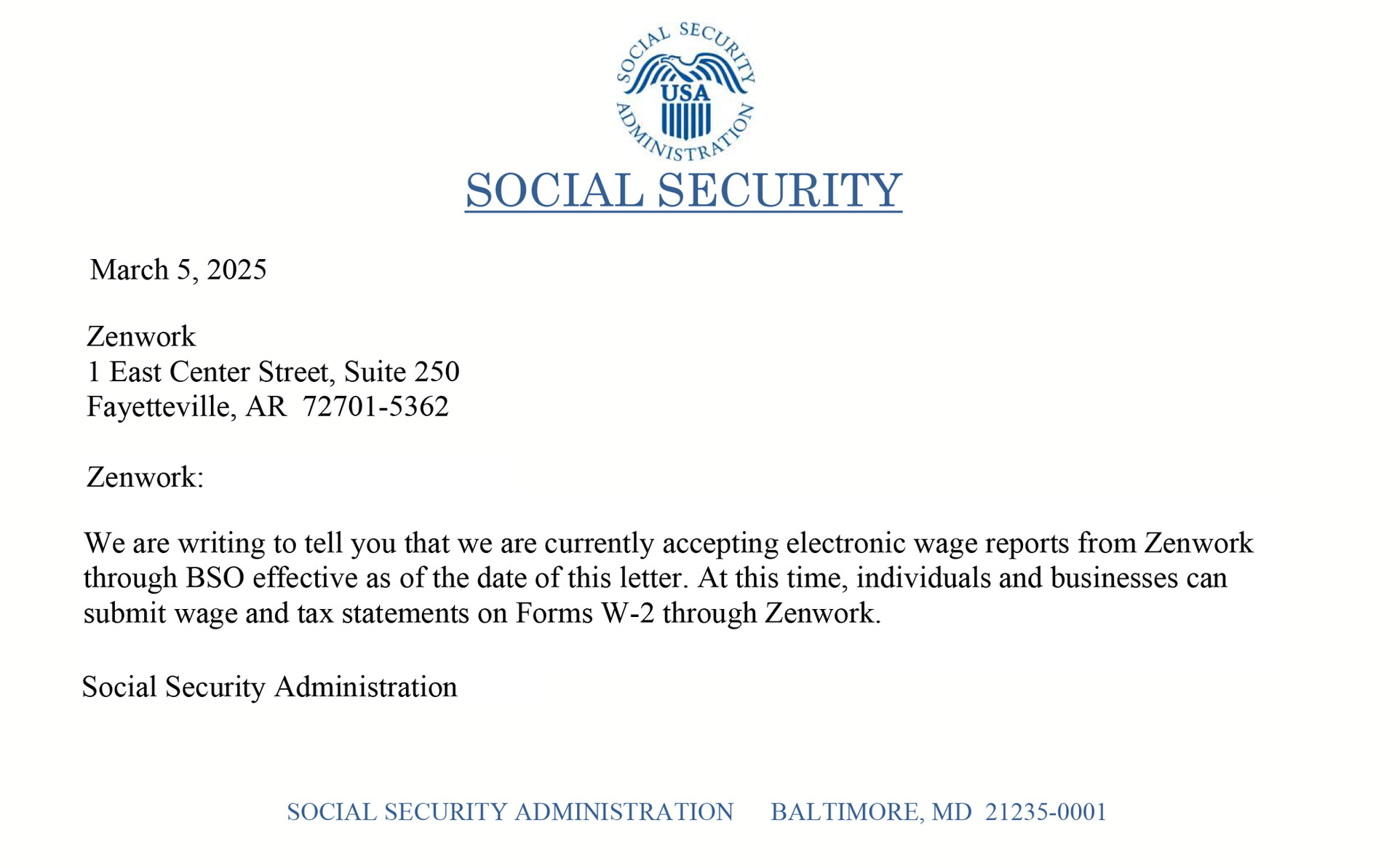
We are pleased to announce that all businesses and individuals can now file W-2 forms with Zenwork. If you previously received a letter from the Social Security Administration (SSA) regarding electronic wage report submissions, please note that the issue has been fully resolved. Our systems are fully operational, and we are processing W-2 and W-2C filings without any disruptions.
Thank you for your continued trust!
1099 Forms
Payroll Forms
STOCK OPTIONS
WAGE TAX FORMS
FORM 592-B
Tax Exempt Forms New
ACA FORMS
1098 FORMS
480 FORMS
Extension Forms
Form 8027
Form 8955-SSA
1042 FORMS
5498 Forms
STATE FILINGS
STATE Payroll Forms
STATE ONLY FILING
WEST
MIDWEST
SOUTH
NORTHEAST
File multiple returns through bulk upload and import data directly via QuickBooks, Xero, etc.
Manage multiple clients with a single sign-on and reduce operation workload with Tax1099.
Create, validate, schedule, and deliver forms effortlessly from a single platform.
Manage W-9, 1099-NEC, and other IRS forms for gig workers with our intuitive platform.
Verify Payees/Merchants with real-time TIN Matching and efile in bulk with our API.
Import and organize your trading data with our real-time data management.
TAX FORM FILING
Data Import & Management
USER & WORKFLOW MANAGEMENT
Validation & Checks
PRINT & DELIVERY
COMPLIANCE & security
ADDITIONAL FEATURES
Integrations
Check out our Product Tour for a smooth Tax1099 experience!
Acquire the help required from our support.
Visual guides to help you work with Tax1099
Explore industry insights & latest updates
Stay up to date about latest IRS updates.
Read the real-life success stories of our users.
The A-Z list for tax-related terms & definitions.
Detailed guides for smarter tax compliance.
Listen to thought-provoking insights and discussions with experts.
Tools
The passage of the One Big Beautiful Bill Act (OBBBA) has created a great deal of buzz as many people anticipate taking advantage of new federal tax deductions related to overtime, tipped income, vehicle loan interest, and the “Senior Bonus.” These provisions may lead to federal tax savings and if you live in Iowa, Montana, North Dakota, or Oregon, you also may see state tax savings. The same, however, cannot be said for tax relief in most other states, at least not for the 2025 tax year.
Here is a breakdown of why state tax relief may prove illusory for many Americans.
To understand why federal tax deductions are not treated the same at the state level, it is important to know the different ways that states handle changes in federal income tax law. Each state chooses whether, how, and to what extent it should align its income tax base with the federal Internal Revenue Code (IRC).
There are three primary ways that states treat the IRC:
These models largely determine whether OBBBA’s federal deductions show up on state returns.
Over one-third of the states follow the rolling conformity model. These states represent 28% of the American population and include New York, Illinois, and Michigan. In theory, these state tax systems would automatically conform to the IRC and provide new personal state tax cuts to their eligible residents.
However, there is a catch. Because OBBBA’s four personal deductions are taken after federal adjusted gross income (“AGI”) in arriving at federal taxable income, rolling-conformity states that piggyback on AGI rather than federal taxable income do not automatically inherit those deductions on their state returns. For residents of these states to obtain these tax deductions, the states would need to take legislative action to change their tax laws.
Several rolling conformity states have taken proactive steps to “decouple” from some or all OBBBA tax provisions.
“Decoupling” is the term used to describe when a state specifically chooses not to follow a federal tax rule in the IRC. Notably, Illinois, Rhode Island, and Washington, DC have decoupled from the above-mentioned four new personal tax deductions created by OBBBA. Colorado passed legislation to decouple from OBBBA’s overtime tax deduction beginning in the 2026 tax year to capture a projected $200 million in state tax revenue that would otherwise be lost. As state legislatures continue to meet through 2026 and review budgets for upcoming years, there may be more decoupling examples coming soon.
Bottom line: Even in rolling conformity states, automatic conformity should not be assumed.
Virginia has temporarily paused automatic (rolling) conformity where federal changes would materially affect General Fund revenues, meaning OBBBA items will not apply unless the General Assembly affirmatively adopts them during the pause window. For now, that means no OBBBA personal deductions on Virginia returns without additional legislative action.
One-third of the states follow the static conformity model. These states represent over 39% of the American population and include California, Ohio, North Carolina, Arizona, and Massachusetts. These states have effectively decided to freeze their own rules on the date they selected for static conformity, giving them time to respond to federal changes without immediate disruption to their budgets.
Static states must advance their conformity date to a post-OBBBA IRC to pick up these deductions. Many states update annually, but not all do. Until they do, residents of these states will generally see none of the four OBBBA personal deductions on their state returns, even if they fully qualify at the federal level. Expect fiscal concerns and budget timing to drive decisions for 2026 and later.
Only five states follow the selective conformity model. These states, consisting of Alabama, Arkansas, Mississippi, New Jersey, and Pennsylvania, represent 10% of the American population.
These five states do not use federal taxable income as the starting point for calculating state tax, so none of the newly enacted personal income tax deductions flow through as state deductions. These states would have to make legislative changes to their taxing processes to pass the new tax deductions to residents. Currently, none of these states have done so.
Eight states do not levy a broad, wage-based personal income tax on their residents but instead rely on other forms of taxation to raise revenue. These states, representing 22% of Americans, are Alaska, Florida, Nevada, New Hampshire, South Dakota, Tennessee, Texas, and Washington. For these states, the new OBBBA personal tax deductions are not applicable for state tax purposes.
Budgets matter: OBBBA’s passage included new retroactive personal deductions not planned for in 2025 state budgets. Even some rolling conformity states that normally follow the IRC have decoupled from OBBBA wary of the significant revenue impacts (Colorado publicly cited revenue concerns in decoupling from the overtime deduction in 2026). Many static conformity states now project hundreds of millions in revenue losses—and multi-billion-dollar hits in large states like California—if they fully adopt all four deductions. Regardless of conformity type, these budget pressures are driving caution as states consider whether to adopt OBBBA’s personal tax cuts. Expect many states to take a wait-and-see approach as their legislatures sort out 2026 budgets.
While OBBBA’s personal deductions are federal wins, the likelihood that those same deductions will be available on state tax returns remains murky. Only residents of a handful of states will receive state deductions for these new tax cuts in 2025. For everyone else, stay tuned as your state plots its path forward!
Stop guessing about multi-state tax implications. Access centralized, regularly updated conformity data to accurately prepare returns and advise clients across multiple jurisdictions. Explore State Conformity Tracker
Access centralized, regularly updated conformity data to accurately prepare returns and advise clients across multiple jurisdictions.