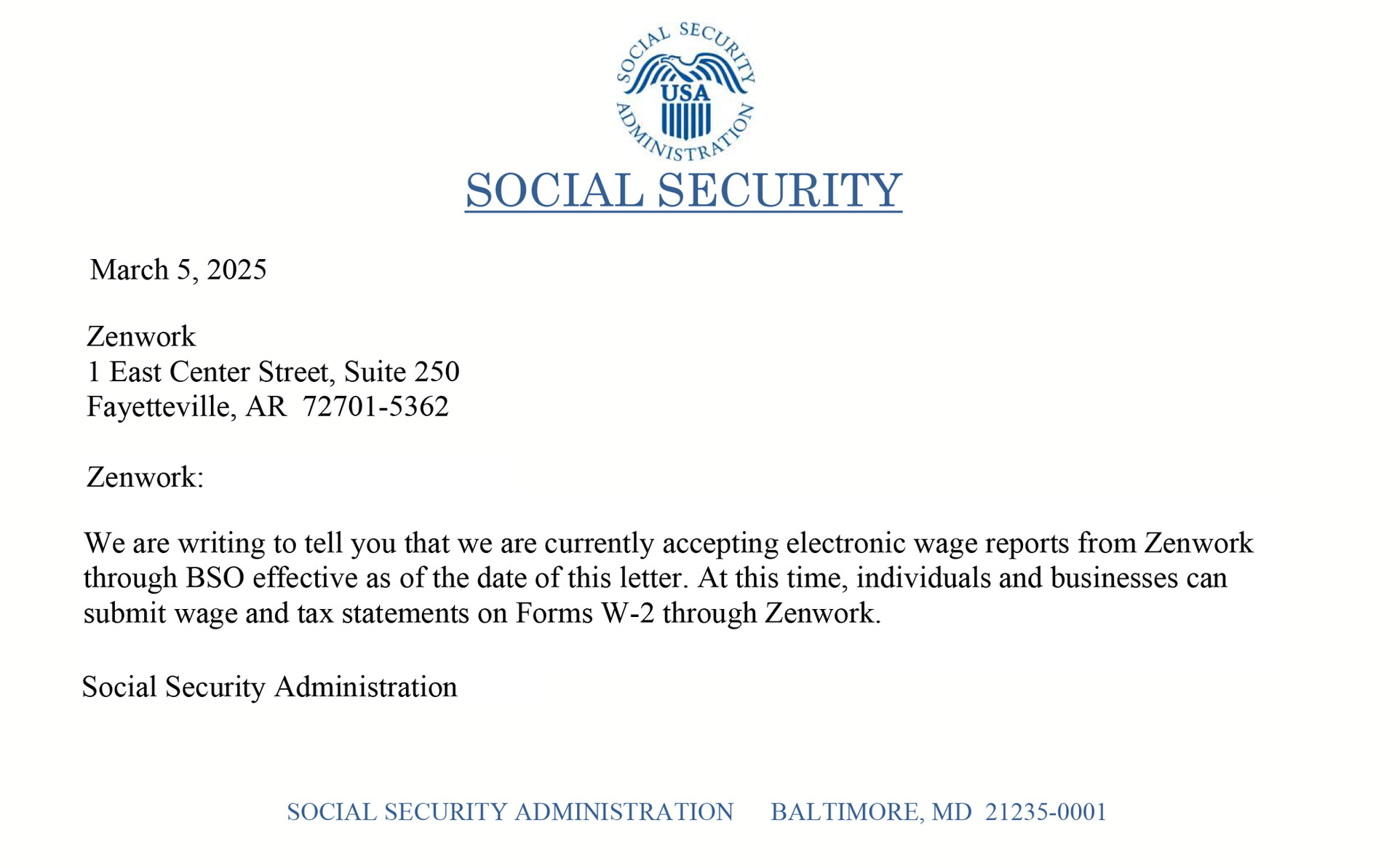
W-2 Filing Available for All Businesses and Individuals
We are pleased to announce that all businesses and individuals can now file W-2 forms with Zenwork. If you previously received a letter from the Social Security Administration (SSA) regarding electronic wage report submissions, please note that the issue has been fully resolved. Our systems are fully operational, and we are processing W-2 and W-2C filings without any disruptions.
Thank you for your continued trust!
1099 Forms
Payroll Forms
STOCK OPTIONS
WAGE TAX FORMS
FORM 592-B
Tax Exempt Forms New
ACA FORMS
1098 FORMS
480 FORMS
Extension Forms
Form 8027
Form 8955-SSA
1042 FORMS
5498 Forms
STATE FILINGS
STATE Payroll Forms
STATE ONLY FILING
WEST
MIDWEST
SOUTH
NORTHEAST
File multiple returns through bulk upload and import data directly via QuickBooks, Xero, etc.
Manage multiple clients with a single sign-on and reduce operation workload with Tax1099.
Create, validate, schedule, and deliver forms effortlessly from a single platform.
Manage W-9, 1099-NEC, and other IRS forms for gig workers with our intuitive platform.
Verify Payees/Merchants with real-time TIN Matching and efile in bulk with our API.
Import and organize your trading data with our real-time data management.
TAX FORM FILING
Data Import & Management
USER & WORKFLOW MANAGEMENT
Validation & Checks
PRINT & DELIVERY
COMPLIANCE & security
ADDITIONAL FEATURES
Integrations
Check out our Product Tour for a smooth Tax1099 experience!
Acquire the help required from our support.
Visual guides to help you work with Tax1099
Explore industry insights & latest updates
Stay up to date about latest IRS updates.
Read the real-life success stories of our users.
The A-Z list for tax-related terms & definitions.
Detailed guides for smarter tax compliance.
Listen to thought-provoking insights and discussions with experts.
Tools
If the headline grabbed your attention, we’ll assume that you’re probably struggling to figure out form 1099-A or you want to know how to file form 1099-A. You’ve come to the right place. In this blog we’ll break down everything about this blog for you to stay penalty free.
The official title of Form 1099-A is “Acquisition or Abandonment of Secured Property”. It’s basically an information return the payers file with the IRS when they take back property from a borrower or when they realize the borrower has walked away from it.
If you’re a bank, credit union, mortgage lender, finance arm, or similar payer, you’ll file Form 1099-A in these two main situations:
There are three copies to pay attention to: Copy A goes to the IRS, Copy B goes to the borrower, and Copy C stays with the lender for your records.
Note: There’s no dollar limit on when you need to file. Even if the property or loan is relatively small, Form 1099-A is required.
Form 1099-A matters for both lenders and borrowers. Why?
When a property is foreclosed or abandoned, the form captures important details like the property’s fair market value and how much was still owed on the loan. These numbers help the IRS determine whether the borrower has taxable gain or loss from a foreclosure. It’s basically the IRS foreclosure reporting form.
For lenders, filing it accurately protects them from penalties and keeps their records audit-ready. The penalties aren’t small. They start at $60 per form and escalate quickly if you’re late or if forms are missing entirely. The penalties increase to $130, then $330, and reach $660 per form for intentional disregard. For borrowers, it’s the document that helps determine their tax obligations after losing property.
Form 1099-A is just one page. But it has some key details:
The IRS uses this information to check if the borrower might have a gain or loss from foreclosure or abandonment.
There’s also an important overlap with Form 1099-C (cancellation of debt):
If, in the same calendar year, you cancel a debt of $600 or more in connection with the foreclosure or abandonment, you may file Form 1099-C only and meet the 1099-A requirement by completing boxes 4, 5, and 7 on Form 1099-C (if you file both forms, do not complete boxes 4, 5, and 7 on Form 1099-C).
This is one special IRS rule that lets a payer use only 1099-C if it already shows all 1099-A details.
Don’t break your head. Refer to these easy-to-follow Form 1099-A instructions to understand what goes where.
Missing 1099-A deadlines 2025 is an easy way to attract penalties. Mark these dates. You’ll thank us later!
The penalties for late filing 1099-A depend on how late you file the form. So, pay attention because it can add up quickly.
This is the penalty structure: $60 (within 30 days), $130 (by August 1), $340 (after August 1 or not filed), and at least $680 per return for intentional disregard (no maximum).
And don’t forget about state requirements. The IRS Combined Federal/State Filing Program doesn’t cover Form 1099-A, so you may need to file separately with your state. Check your state’s specific rules.
Keep all your documentation handy. Deeds, appraisals, correspondence with borrowers for at least four years. In case of an audit, you’ll be glad you did.
Another tip: If you resell a vehicle within 90 days, you typically won’t need a second 1099-A. You might need a 1099-C later if you forgive part of the remaining debt.
Here’s an easy 1099-A step-by-step filing guide using Tax1099:
1. Bank forecloses a home with a $210,000 loan balance, but the fair market value is $200,000.
Correct Action: On your 1099-A, Box 2 shows $210,000, Box 4 shows $200,000, and check Box 5
2. A tenant abandons a rental property, leaving the keys behind. The loan has a recourse.
Correct action: File Form 1099-C only if boxes 4, 5, and 7 include all 1099-A information. Otherwise, file both forms.
3. Credit union forecloses on a property and forgives $15,000 of debt.
Correct action: File both 1099-A and 1099-C.
4. Auto lender repossess an SUV after missed payments.
Correct action: File 1099-A showing the repossession date and the auction fair market value.
5. The city seizes farm equipment, and the borrower has no personal liability.
Correct action: File 1099-A but leave Box 5 blank.
No. File for any foreclosure or abandonment, regardless of the property value.
File one form per borrower. If they’re married and share the same address and jointly liable, then file just one.
Only if they’re listed as borrowers on the loan.
Only if the payer purchased the property for that exact amount.
Yes, once they’ve signed a consent form for electronic delivery.
Send both, or use the combined filing option if all 1099-A information fits on 1099-C.
Filing Form 1099-A shouldn’t stress you out. Let Tax1099 do the heavy-lifting so that you can focus on running your business instead! Start filing now
Filing Form 1099-A shouldn’t stress you out. Let Tax1099 do the heavy-lifting so that you can focus on running your business instead!