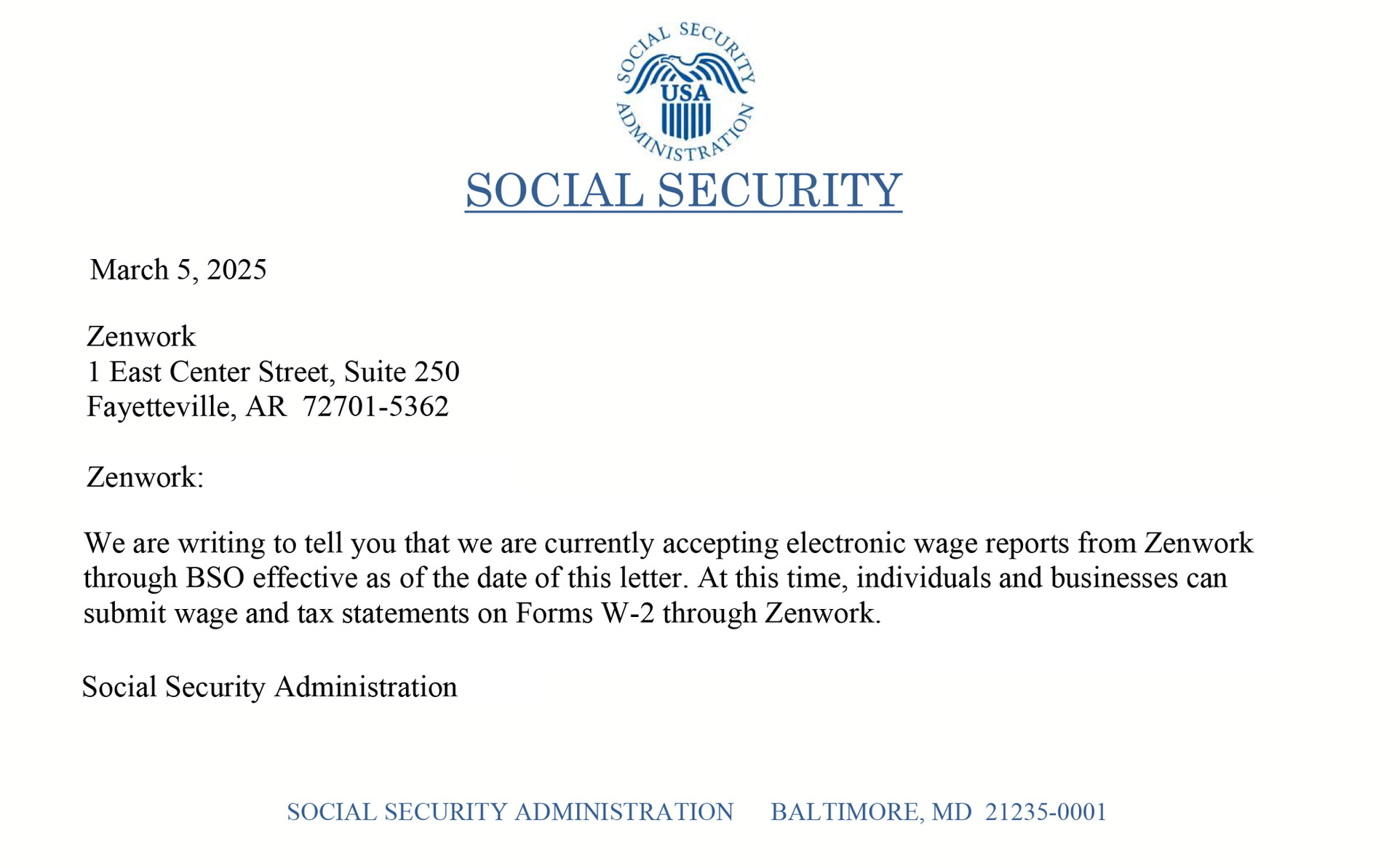
W-2 Filing Available for All Businesses and Individuals
We are pleased to announce that all businesses and individuals can now file W-2 forms with Zenwork. If you previously received a letter from the Social Security Administration (SSA) regarding electronic wage report submissions, please note that the issue has been fully resolved. Our systems are fully operational, and we are processing W-2 and W-2C filings without any disruptions.
Thank you for your continued trust!
1099 Forms
Payroll Forms
STOCK OPTIONS
WAGE TAX FORMS
FORM 592-B
Tax Exempt Forms New
ACA FORMS
1098 FORMS
480 FORMS
Extension Forms
Form 8027
Form 8955-SSA
1042 FORMS
5498 Forms
STATE FILINGS
STATE Payroll Forms
STATE ONLY FILING
WEST
MIDWEST
SOUTH
NORTHEAST
File multiple returns through bulk upload and import data directly via QuickBooks, Xero, etc.
Manage multiple clients with a single sign-on and reduce operation workload with Tax1099.
Create, validate, schedule, and deliver forms effortlessly from a single platform.
Manage W-9, 1099-NEC, and other IRS forms for gig workers with our intuitive platform.
Verify Payees/Merchants with real-time TIN Matching and efile in bulk with our API.
Import and organize your trading data with our real-time data management.
TAX FORM FILING
Data Import & Management
USER & WORKFLOW MANAGEMENT
Validation & Checks
PRINT & DELIVERY
COMPLIANCE & security
ADDITIONAL FEATURES
Integrations
Check out our Product Tour for a smooth Tax1099 experience!
Acquire the help required from our support.
Visual guides to help you work with Tax1099
Explore industry insights & latest updates
Stay up to date about latest IRS updates.
Read the real-life success stories of our users.
The A-Z list for tax-related terms & definitions.
Detailed guides for smarter tax compliance.
Listen to thought-provoking insights and discussions with experts.
Tools
Payers often work with multiple types of year-end distributions, which means choosing the correct 1099 form is essential to stay compliant. Two forms that are commonly mixed up are Form 1099-R and Form 1099-DIV.
Each serves a completely different purpose, yet both are key reporting tools for the IRS. A retirement payout and a dividend distribution are not interchangeable, and selecting the wrong form can create CP2000 notices to the payee (taxpayer), require a two-step correction filing, and lead to avoidable IRS penalties.
This 1099-R vs 1099-DIV payer guide walks you through what each form reports, when each is required, and how to avoid the most common filing errors.
Form 1099-R is used to report designated distributions of $10 or more from pensions, retirement or profit-sharing plans, annuities, IRAs, insurance contracts, etc. It also applies when federal income tax is withheld under section 3405 on a designated distribution.
The form covers distributions from IRAs, 401(k) plans, 403(b) plans, 457(b) plans, profit-sharing plans, pensions, annuities, life insurance contracts with cash value, and designated Roth accounts. These arrangements fall under retirement distribution reporting rules and must be reported even when the withdrawn amount is fully nontaxable.
Note: Form 1099-R doesn’t apply in all situations:
Payers that file Form 1099-R generally include plan administrators, banks, trust companies, credit unions, brokerage firms, and insurance carriers responsible for annuities or life insurance products with distribution activity.
Form 1099-DIV is used to report dividend income and other shareholder distributions. It covers ordinary dividends, qualified dividends, capital gain distributions, Section 199A dividends, and liquidating distributions. Payers must issue Form 1099-DIV when dividends and other distributions on stock total $10 or more, liquidation distributions total $600 or more, or when any federal income or foreign tax is withheld on dividends.
Note: Form 1099-DIV doesn’t apply in all situations:
Payers required to file Form 1099-DIV include C corporations, mutual funds/RICs, REITs, ETFs (generally RICs), and S corporations for reportable distributions. Brokers and clearing firms may also issue the form as part of a consolidated 1099 package.
Choosing the correct form helps payers avoid significant compliance issues. Incorrect forms can trigger IRS mismatch notices (CP2000) or backup withholding under IRC §3406. Penalties range from $60 to $340 per form, and intentional disregard penalties are $680 per form. States often mirror these penalties.
Payers should issue Form 1099-R for transactions such as:
Form 1099-DIV is used for corporate earnings or liquidation events, including:
Yes. Report the gross amount in Box 1 and 0 in Box 2a, and use Code G or H for direct rollovers.
Generally, no. Corporate recipients are excluded under Exceptions.
Qualified dividends appear in Box 1b and count toward the $10 reporting threshold.
The payer must file Form 1099-DIV—backup withholding triggers reporting regardless of the amount.
Yes. If they receive both retirement and dividend payments.
Keep records for at least 3 years (4 if backup withholding applied).
Stay compliant and penalty-free-use Tax1099 to validate TINs up front, apply the correct 1099-R Box 7 codes and 1099-DIV boxes, and e-file accurately and on time with IRS acknowledgments.