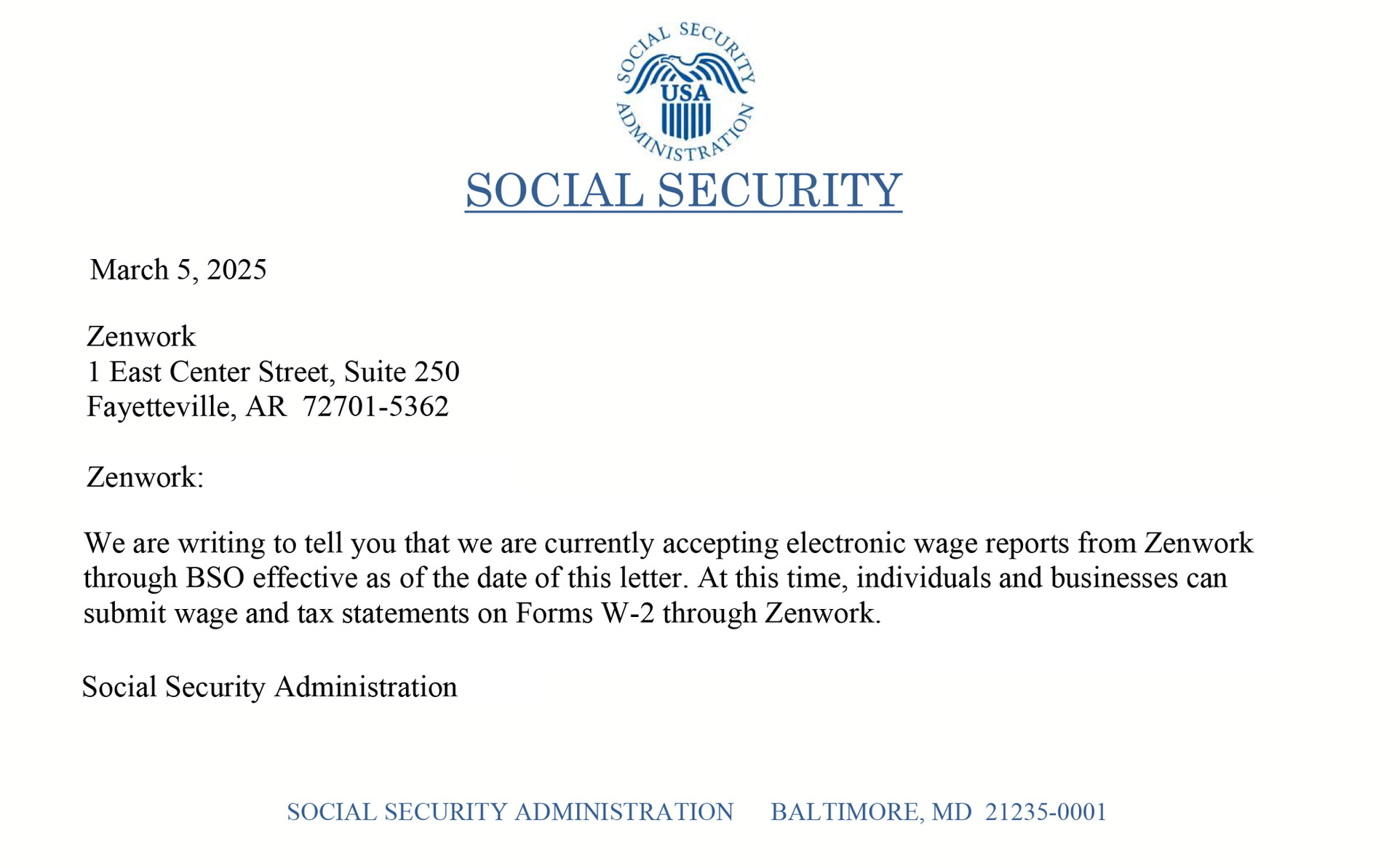
W-2 Filing Available for All Businesses and Individuals
We are pleased to announce that all businesses and individuals can now file W-2 forms with Zenwork. If you previously received a letter from the Social Security Administration (SSA) regarding electronic wage report submissions, please note that the issue has been fully resolved. Our systems are fully operational, and we are processing W-2 and W-2C filings without any disruptions.
Thank you for your continued trust!
1099 Forms
Payroll Forms
STOCK OPTIONS
WAGE TAX FORMS
FORM 592-B
Tax Exempt Forms New
ACA FORMS
1098 FORMS
480 FORMS
Extension Forms
Form 8027
Form 8955-SSA
1042 FORMS
5498 Forms
STATE FILINGS
STATE Payroll Forms
STATE ONLY FILING
WEST
MIDWEST
SOUTH
NORTHEAST
File multiple returns through bulk upload and import data directly via QuickBooks, Xero, etc.
Manage multiple clients with a single sign-on and reduce operation workload with Tax1099.
Create, validate, schedule, and deliver forms effortlessly from a single platform.
Manage W-9, 1099-NEC, and other IRS forms for gig workers with our intuitive platform.
Verify Payees/Merchants with real-time TIN Matching and efile in bulk with our API.
Import and organize your trading data with our real-time data management.
TAX FORM FILING
Data Import & Management
USER & WORKFLOW MANAGEMENT
Validation & Checks
PRINT & DELIVERY
COMPLIANCE & security
ADDITIONAL FEATURES
Integrations
Check out our Product Tour for a smooth Tax1099 experience!
Acquire the help required from our support.
Visual guides to help you work with Tax1099
Explore industry insights & latest updates
Stay up to date about latest IRS updates.
Read the real-life success stories of our users.
The A-Z list for tax-related terms & definitions.
Detailed guides for smarter tax compliance.
Listen to thought-provoking insights and discussions with experts.
Tools
Companies that process payments through credit cards and digital platforms face a heavy reporting crush at the start of each year, and 2026 will be no different. The IRS expects Form 1099-K to be filed accurately and on time, and late or incorrect filings can trigger avoidable penalties.
This guide walks you through the key Form 1099-K 2026 deadlines, federal and state thresholds, exceptions, and e-file options so you can manage the Form 1099-K reporting cycle with fewer surprises.
Form 1099-K is used to report the total dollar amount a seller received through card transactions or through a third-party network during the year. It’s designed to give the IRS visibility into payments that flow through platforms rather than traditional invoicing channels.
Payers that must issue the form include:
Form 1099-K shows gross payments before fees, refunds, chargebacks, or other adjustments because the IRS relies on this total to confirm that income was reported correctly. A copy must be provided to both the seller and the IRS for all reportable payment card transactions and, for third-party network transactions, when the federal reporting threshold is exceeded or whenever any amount of backup withholding has been applied.
Below are the 1099-K due dates for reporting 2025 payment activity during the 2026 tax season.
Payers typically issue seller copies first. Any responses received from sellers, such as updated addresses or name/TIN corrections, can be fixed before the IRS deadline to reduce mismatch notices later.
The filing thresholds for Form 1099-K have changed several times in recent years. The IRS adopted a phased approach to help payers adjust.
Amounts such as shipping charges, sales tax, and tips usually count toward the gross total.
Expert Tip: Maintain clear records throughout the year to make sure that the totals align with what must be reported.
The majority of states get Form 1099-K data directly from the IRS via the Combined Federal/State Filing (CF/SF) program. Nevertheless, some jurisdictions still require a separate direct filing even if they participate in CF/SF. For example, the District of Columbia participates in CF/SF but requires a direct state submission, and Wisconsin requires direct filing for 1099s with Wisconsin withholding, even if you use CF/SF. Always confirm your state’s current rules.
Platforms such as Tax1099 can automatically submit state copies on the same day the federal file is sent, which helps payers stay compliant with both sets of rules.
Payers that need a 1099-K extension, i.e., additional time to file the form, can request an extension with Form 8809. This form generally grants a 30-day extension to file with the IRS when Form 8809 is filed by the original due date of the information returns, and for most forms (other than Forms 1099-NEC, W-2, and certain others), that extension is automatic. However, the extension applies only to the IRS filing deadline, not the date seller copies are due.
As for the mandatory 10-returns e-file rule, if a payer files 10 or more information returns of any type combined (for example, Forms 1099, W-2, or 1042-S), e-filing is required, unless the payer has a waiver, exempting them from e-filing.
The IRS may assess penalties when forms are filed late, incorrectly, or not at all. Below are the standard penalty amounts for returns filed during 2026:
One way to lessen the risk of incurring penalties is by keeping TIN records precise, examining totals prior to filing, and dispatching seller duplicates early to reveal any differences.
Keep your Form 1099-K reporting on track with this simple timeline:
After filing, keep copies of information returns (or be able to reconstruct the data) for at least three years from the due date—four years if backup withholding was imposed.
Yes. Paper filing is allowed when the payer submits fewer than 10 total information returns across all form types.
No. Seller copies must be provided by February 2, 2026, even if an IRS extension is requested.
A corrected Form 1099-K should be issued as soon as possible. Early corrections reduce the risk of penalties.
Some states, such as Vermont and Wisconsin, may set earlier reporting dates. Filing platforms check state rules automatically.
No. Personal gifts and reimbursements that are marked as “non-business” are not reportable.
For 2026 filings, furnish 1099-K payee copies by Monday, February 2, 2026, file with the IRS by March 2, 2026, on paper (only if you file fewer than 10 total information returns or have a waiver) or by March 31, 2026, electronically. Note that Form 8809 can extend only the IRS filing deadline—not the payee copy date.
Stay penalty-safe and on schedule with Tax1099. Import payouts (CSV/Excel/API), run TIN Match, deliver recipient copies timely (email/mail), auto-route required state copies, e-file through IRIS, get IRS acknowledgments, and submit corrections quickly. Start e-filing 1099-K now with Tax1099.
Stay penalty-safe and on schedule with Tax1099. Import payouts (CSV/Excel/API), run TIN Match, deliver recipient copies timely (email/mail), auto-route required state copies, e-file through IRIS, get IRS acknowledgments, and submit corrections quickly.