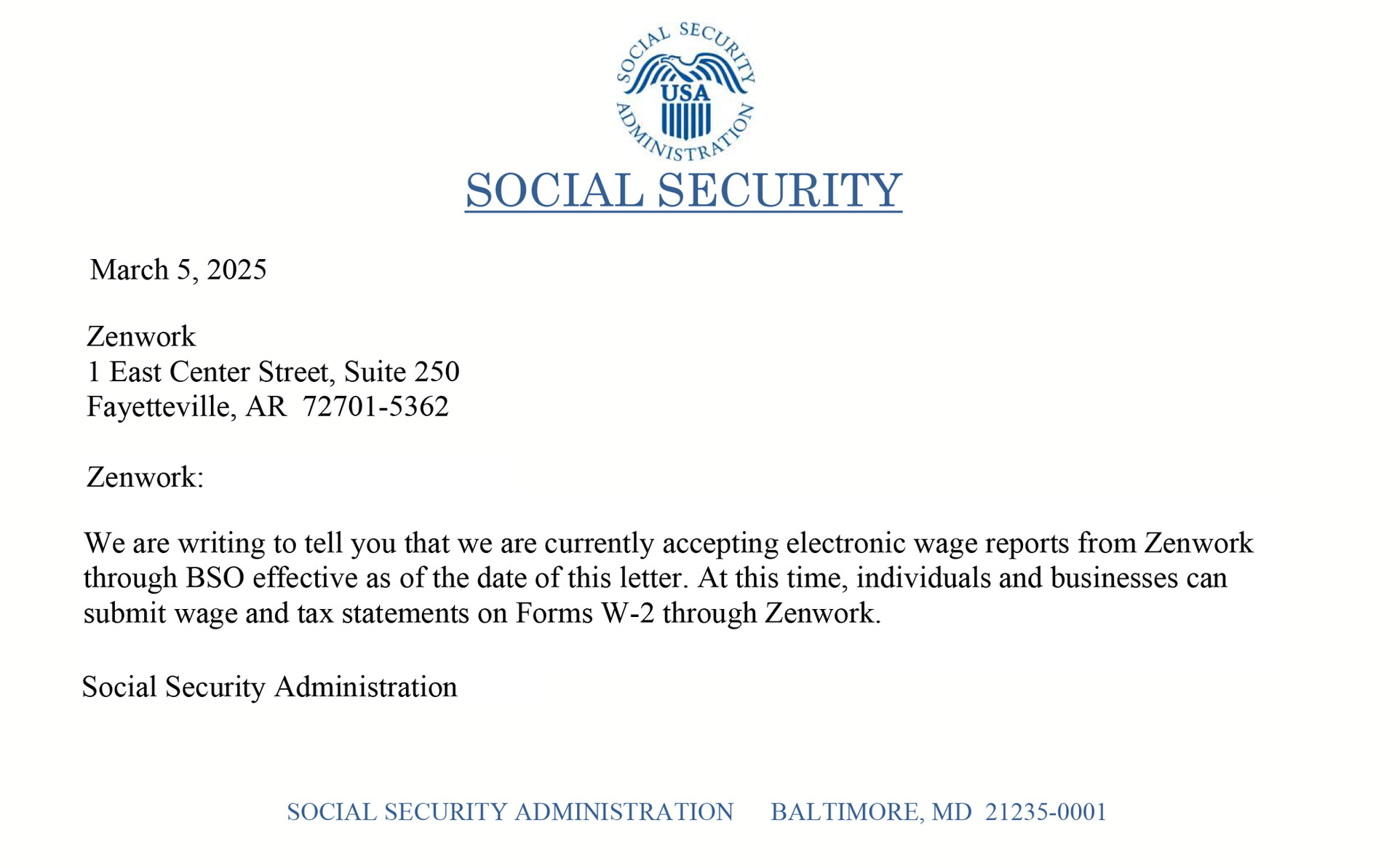
W-2 Filing Available for All Businesses and Individuals
We are pleased to announce that all businesses and individuals can now file W-2 forms with Zenwork. If you previously received a letter from the Social Security Administration (SSA) regarding electronic wage report submissions, please note that the issue has been fully resolved. Our systems are fully operational, and we are processing W-2 and W-2C filings without any disruptions.
Thank you for your continued trust!
1099 Forms
Payroll Forms
STOCK OPTIONS
WAGE TAX FORMS
FORM 592-B
Tax Exempt Forms New
ACA FORMS
1098 FORMS
480 FORMS
Extension Forms
Form 8027
Form 8955-SSA
1042 FORMS
5498 Forms
STATE FILINGS
STATE Payroll Forms
STATE ONLY FILING
WEST
MIDWEST
SOUTH
NORTHEAST
File multiple returns through bulk upload and import data directly via QuickBooks, Xero, etc.
Manage multiple clients with a single sign-on and reduce operation workload with Tax1099.
Create, validate, schedule, and deliver forms effortlessly from a single platform.
Manage W-9, 1099-NEC, and other IRS forms for gig workers with our intuitive platform.
Verify Payees/Merchants with real-time TIN Matching and efile in bulk with our API.
Import and organize your trading data with our real-time data management.
TAX FORM FILING
Data Import & Management
USER & WORKFLOW MANAGEMENT
Validation & Checks
PRINT & DELIVERY
COMPLIANCE & security
ADDITIONAL FEATURES
Integrations
Check out our Product Tour for a smooth Tax1099 experience!
Acquire the help required from our support.
Visual guides to help you work with Tax1099
Explore industry insights & latest updates
Stay up to date about latest IRS updates.
Read the real-life success stories of our users.
The A-Z list for tax-related terms & definitions.
Detailed guides for smarter tax compliance.
Listen to thought-provoking insights and discussions with experts.
Tools
Form 1099-B and Form 1099-R must be distinguished by any payer handling both investment sales and retirement distributions. The 1099-B or 1099-R difference rests on the money source. One tracks assets sold from a brokerage account, and the other tracks funds withdrawn from a tax-advantaged retirement plan. Getting this right is critical. This guide covers the key rules so payers can send the correct form and ensure penalty-free filing.
When investments, like stocks, bonds, mutual funds, options, or assets traded through a barter exchange, are sold through a broker or exchange, the IRS requires a record of the transaction. The sale price, date, and other details are used to determine the taxpayer’s gain or loss. Form 1099-B is the form that provides that record.
(Note: Starting January 1, 2025, sales of digital assets are reported separately on Form 1099-DA. The digital asset broker that effected the sale must prepare and send the form.)
Form 1099-B is required when a broker or barter exchange effects a sale for a customer—there’s no minimum dollar threshold, but do not file for exempt recipients.
What the payer needs to report on the form includes:
Form 1099-R is the form used to report money removed from a retirement account. This includes payouts from pensions, IRAs, 401(k) plans, annuities, and similar retirement plans. The IRS uses it to understand how much was withdrawn and how much of that amount is taxable.
The payer, trustee, or plan administrator who makes the distribution must file Form 1099-R. They must file it when the payout is $10 or more.
What the payer reports on the form:
Box 1 – Gross distribution
This shows the full amount that was withdrawn from the retirement account, even if part of it isn’t taxable.
Box 2a – Taxable amount
This is the portion of the distribution the IRS treats as taxable income for the year. Sometimes it matches Box 1, and sometimes it’s lower depending on the type of account and contributions.
Box 7 – Distribution code(s)
This code explains why the money was withdrawn. For example, an early withdrawal, a normal retirement payout, or a rollover (Code G).
These codes help the IRS understand how the distribution should be taxed.
Choosing the wrong form affects both the payer and the person receiving the statement. The IRS applies penalties for information returns due in 2026—
Getting the form right the first time prevents avoidable rework. When the payer files the wrong form, the recipient can’t report their income correctly, and the payer must correct and resend the statements.
Accurate forms also help maintain trust. Investors, retirement plan members, and other recipients rely on these documents to be clear and correct, and consistent accuracy reflects well on the payer.
Clean reporting further reduces IRS follow-up. When the information matches IRS records, the likelihood of audit letters or CP2000 mismatch notices drops significantly.
Here are the key payer 1099-B rules and what the IRS expects:
Payers must file Form 1099-R for each person to whom they made a designated distribution of $10 or more. Here are the payer 1099-R rules and what the IRS expects:
Note: Do not report trustee-to-trustee transfers between IRAs where no payment is made to the participant.
Understanding the 1099 deadlines for tax year 2025 (due in 2026) is essential for timely filing:
To extend time to furnish recipient statements, fax Form 15397 so it’s received by the recipient due date; if approved, the IRS generally grants up to 30 extra days (this extension is not automatic).
Once you’ve separated investment sales from retirement distributions, the next step is filing them accurately and on time.
No. If the sale happens inside a retirement account, the payer does not issue Form 1099-B. Any money that leaves the plan is reported on Form 1099-R instead.
For brokered sales, there is no minimum dollar amount. For barter exchanges, Form 1099-B is not required if the fair market value of the property or services exchanged is less than $1. Also, do not file for exempt recipients (for example, corporations and IRAs).
Yes. A Roth conversion is treated as a distribution from the original account, so it must be reported on Form 1099-R.
Any federal tax withheld from the sale is shown on Form 1099-B. The payer includes it along with the sale proceeds and cost basis.
The payer must correct it. Filing the wrong form can delay the recipient’s tax filing and may lead to IRS penalties. The payer needs to issue the correct form and fix the mistake as soon as possible.
For Form 1099-B, corporations are generally exempt recipients—do not file for broker transactions—except for barter exchange transactions and certain S corporation sales (for covered securities acquired after 2011). For Form 1099-R, file for each person to whom you made a designated distribution of $10 or more (typically individuals; estates or trusts may also be recipients).
When you clearly separate brokerage sales from retirement distributions, choose the right form, and apply the correct boxes and codes, 1099-B and 1099-R reporting becomes much more predictable. Getting this right the first time helps recipients report their income correctly, reduces the risk of CP2000 mismatch notices, and keeps IRS penalties at bay.
When you use Tax1099, you are able to upload or import transaction data, run TIN validity checks, and e-file both forms in one workflow instead of juggling spreadsheets.
Stay compliant and save time—use Tax1099 to e-file accurate 1099-B and 1099-R forms, send payee copies, and manage corrections before 2026 deadlines hit.